
Reviewed · DABBAWALA TIFFIN TOURS
Morning Life of Mumbai’s Dabbawalas and Dhobis Tour
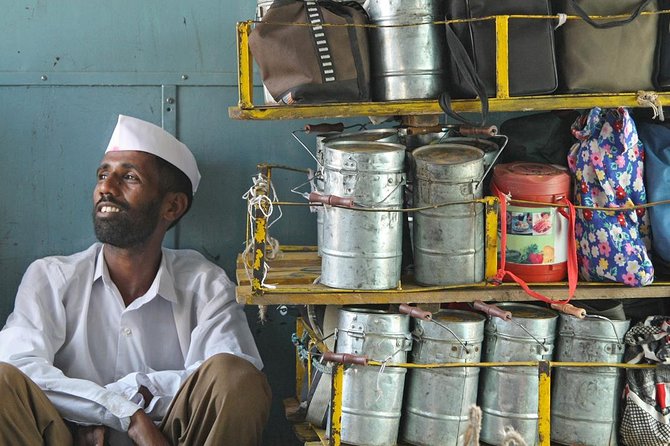
Mumbai’s famous dabbawalas turn a railway platform into a carefully timed food-delivery operation. At Churchgate, you watch lunch boxes arrive by train, get sorted into wooden carts and trolleys, then head out toward office workers across the city. It is a quick, practical look at a system built around local trains, human coordination, and remarkable accuracy.
I like two things right away: you get to ride a Mumbai local train instead of only looking at the city through a car window, and you visit Dhobi Ghat, where laundry is still washed, beaten, dried, and pressed in a huge open-air work area. The private format also gives you room to ask questions. The main drawback is value. At $77 per person, the tour costs more than arranging a local train ride and visiting Dhobi Ghat yourself.
Key points to know before booking
- Churchgate is the working heart of the dabbawala visit: Watch lunch boxes come off the train, get sorted, and move into delivery carts.
- The local train ride is included: Your ticket from Churchgate to Mahalaxmi is covered, adding a genuine slice of everyday Mumbai travel.
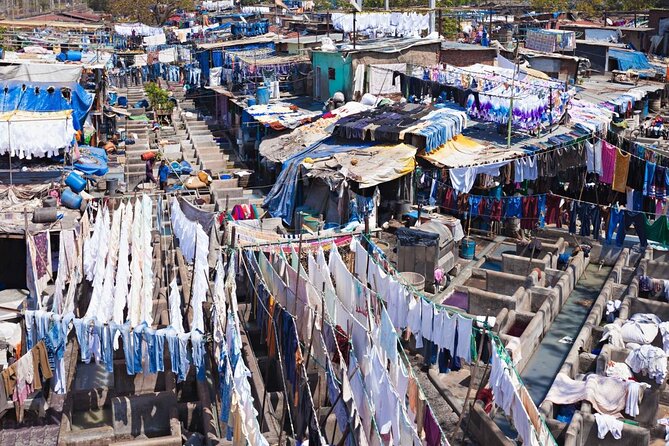
- Dhobi Ghat is more than a photo stop: You see clothes washed in sudsy water, struck against flogging stones, placed in vats, and hung to dry.
- You get a private guide and hotel transport: This suits you if you want the city’s transport and work systems explained as you go.
- Guide quality matters: Arun and Sangeeta received especially warm comments, though your assigned guide may be different.
- The tour has mixed feedback: Some guests praise the guide and comfortable car, while others report poor communication and too little explanation during drives.
Why Mumbai’s working routines make this tour different
Many city tours point you toward monuments, markets, and grand buildings. This one focuses on people doing ordinary work at an extraordinary scale. The dabbawalas carry freshly prepared meals from homes to offices, while the Dhobis handle laundry for customers across Mumbai.
That focus gives you a useful view of daily life. You are not simply passing a landmark and hearing a date. You are watching two services function in real time, with trains, carts, sorting areas, washing stations, and family occupations all tied together.
The dabbawala portion is especially useful if you enjoy seeing how a city solves practical problems. Home-cooked food has to travel from one part of Mumbai to another, arrive at the right office, and later return to the correct home. The system is associated with 100 percent accuracy, a claim that helps explain why this modest-looking delivery service has become one of Mumbai’s best-known working institutions.
The Dhobi Ghat visit provides a different lesson. It shows how a traditional service operates in a large modern city. More than 200 Dhobis and their families work together in the open-air laundry area, and the occupation has traditionally passed from one generation to the next.
More dabbawala tours in Mumbai
- Private Combo Tours Sightseeing + Dharavi Slum + Dhobi Ghat & Dabbawalas
★ 5.0 · 245 reviews - Dabbawala, Dhobi Ghat & Dharavi slum Tour with Local Train Ride
★ 5.0 · 102 reviews - Mumbai Gems: 2-Day Private Tour with Elephanta, Slum & Dabbawala
★ 5.0 · 63 reviews
Starting at Churchgate Railway Station
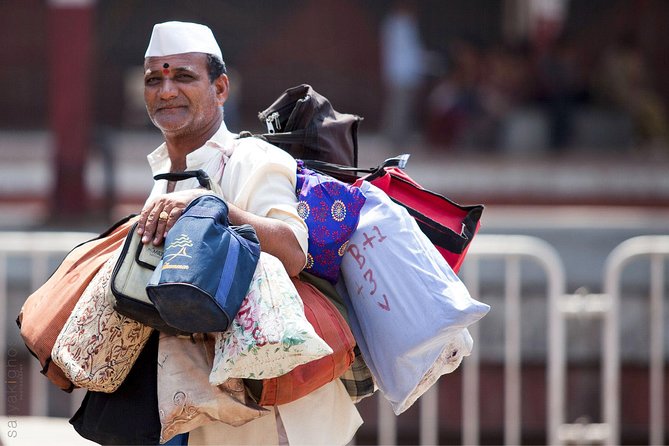
The tour begins with pickup from your hotel, with the stated start time at 10:00 a.m. Your guide takes you to Churchgate Railway Station, where the dabbawalas arrive with their lunch boxes, known locally as dabbas.
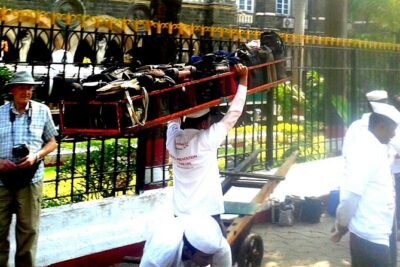
This is the most time-sensitive part of the outing. The work happens around the trains, not inside a staged display. You may see the dabbawalas disembark and unload boxes from wooden carts. The dabbas are then separated according to destination and transferred to trolleys for the next part of delivery.
You are escorted toward the platform rather than left to figure out the station alone. That matters in a busy railway setting, especially if you do not know which train or platform connects with the next stop. The tour includes the train ticket from Churchgate to Mahalaxmi.
The itinerary allows about 30 minutes at Churchgate. That is enough for a close look at the sorting process, but it is not a leisurely station tour. Keep your attention on the work. The point is to see the quick handoffs and the flow of boxes, not to linger over every detail of the station.
I like this stop because it places you beside a real city service at the moment when it matters most. You see the delivery chain as a physical process: train, platform, cart, trolley, and final distribution. Ask your guide to explain the markings on the dabbas and how the boxes are separated. The quality of the explanation will shape how much you take away from the visit.
Riding from Churchgate to Mahalaxmi
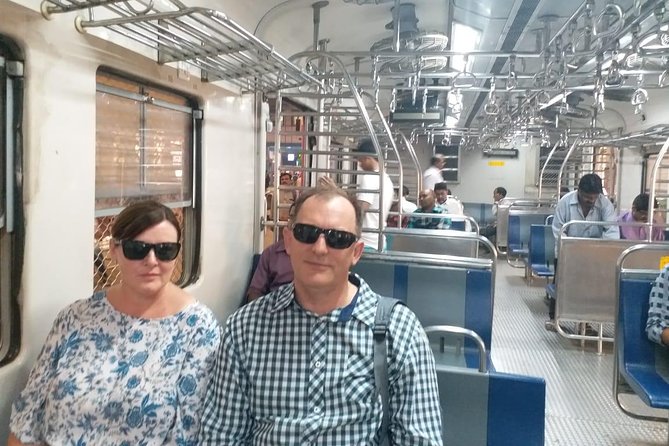
The train ride is short, but it changes the feel of the tour. Instead of moving directly between attractions in a private car, you travel as local commuters do, at least for one section of the route.
That choice adds value for anyone interested in how Mumbai works from the ground up. The train is not an optional add-on. It is part of the story, because the dabbawalas use the railway network to move lunch boxes around the city.
You should wear comfortable walking shoes. The tour includes station movement, platform access, and time on foot at Dhobi Ghat. Smart-casual clothing is requested, and practical clothes will serve you better than anything formal.
The private format should make the train transfer easier. Your guide is expected to escort you, provide the ticket, and keep the morning moving. Still, the experience is not a private train carriage. You are joining a public transport system, so the ride may feel more crowded and less controlled than the car portions of the outing.
Seeing the work at Dhobi Ghat
After the train ride, you continue to Mahalaxmi and visit Dhobi Ghat. The tour allows about 40 minutes here.
A Dhobi collects dirty clothes, washes them, dries them, and returns them neatly pressed. At the ghat, the laundry is handled in a large open-air area. Clothes are soaked in sudsy water, struck against flogging stones, moved into large vats, and hung out to dry.
That sequence makes the visit more useful than a quick photograph from the road. You get a look at the physical effort behind a service many people take for granted. The setting also shows how work, family, and inherited occupation can exist side by side in a major city.
The area is active and practical rather than polished for sightseeing. You should expect a working place, not a museum. Your guide’s role is important here, since the washing methods, family structure, and daily routines may otherwise be hard to understand from a short visit.
The 40-minute stop is enough to see the basic process and ask questions. It may feel brief if you want detailed photography or a long conversation about each stage. On the other hand, the compact visit keeps the tour from becoming repetitive and leaves time for hotel return.
More early morning tours in Mumbai
- The Original Mumbai by Dawn – Recommended by Nigella Lawson & Nat Geo Traveller!
★ 5.0 · 610 reviews - Mumbai Morning Market Tour of Flowers, Fish, and More
★ 5.0 · 100 reviews - Mumbai Private Sunrise/Sunset Sailing 8ppl Boat Tour
★ 4.5 · 86 reviews - Mumbai Morning Market Tour of Flowers, Fish, and More
★ 5.0 · 82 reviews
How the private format affects the experience
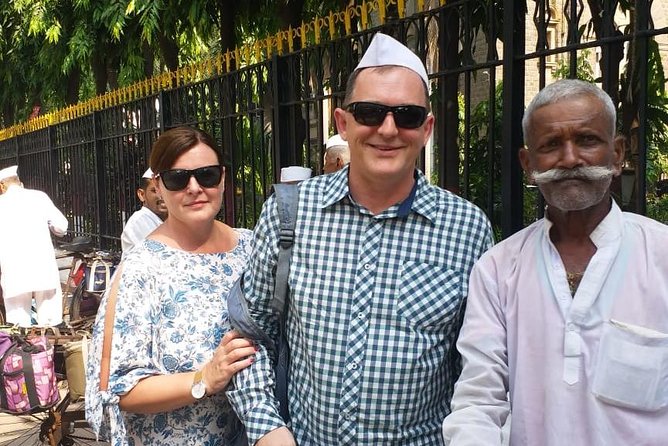
Only your group participates, and a professional guide accompanies you. Hotel pickup and drop-off are included, which removes the need to arrange taxis between the station, Dhobi Ghat, and your accommodation.
I see the private setup as most valuable for first-time visitors who want help with Mumbai’s transport system. A guide can connect the dabbawala work to the train ride and explain why the railway matters to the city’s daily routines.
It is less valuable if you are already comfortable using Mumbai public transport and can arrange the route yourself. One guest felt the tour could easily be done independently and considered the price too high. That is a fair criticism. The paid service is mainly for interpretation, coordination, and convenience, not exclusive access to a private attraction.
Guide quality can also vary. Arun was praised for explaining many aspects of Mumbai life during the three-hour outing, and Sangeeta was described as very good once the early confusion had been cleared up. These comments suggest that a strong guide can make the short itinerary feel full and connected.
There was also a serious complaint about limited attention and very little explanation during a long drive. Another guest reported confusion before departure over the pickup city and a delay caused by an unscheduled protest. These problems do not define every departure, but they show why you should confirm your Mumbai hotel and pickup details carefully before the day.
What the $77 price buys you
The stated price is $77 per person. It includes a professional guide, hotel pickup and drop-off, and the train ticket from Churchgate to Mahalaxmi. Food and drinks are not included.
For a solo visitor or a small group, the price pays for a private car connection, an organized station transfer, and local explanation. The round-trip hotel transport is helpful because the tour begins at a railway station and ends after the Dhobi Ghat visit, rather than at a single central meeting point.
The value becomes harder to defend if you are traveling with only a casual interest in the subject or already know Mumbai’s train system. The core sights are public places, and there is no meal or special entry included. Group discounts may improve the calculation for larger parties, but you should compare the final per-person price before booking.
I would pay the price if I wanted a structured introduction to Mumbai’s working life and did not want to manage the train connection myself. I would skip it if my priority were famous buildings, markets, or a longer guided city tour.
Timing, comfort, and practical concerns
The advertised duration is about three hours. The listed stops account for roughly 70 minutes, with the remaining time used for hotel transfers, station movement, the train ride, and the return journey.
That means the experience is compact. You get two focused visits rather than a full-day exploration of Mumbai. The short length works well if you have limited time or want to leave the afternoon open.
Pickup is offered, and the activity is near public transportation. Most people can participate, but you should be ready to walk through a railway station and stand or move around during the working demonstrations. Comfortable shoes are specifically recommended.
Bring water if you need it, since food and drinks are not provided. Dress smart casual, as requested. The tour is not presented as a luxury outing, despite the private transport. Its appeal is access to working parts of the city and the ease of having someone organize the route.
The overall rating is 3.1 from 11 published ratings, so I would book with realistic expectations. The strongest experiences depend on clear pickup arrangements and a guide who explains what you are seeing. The mixed score is a reason to confirm details, not necessarily a reason to dismiss the concept.
Who will get the most from this Mumbai tour
I recommend it most for first-time visitors who want a short, people-focused experience. It suits you if you enjoy public transport, ordinary work routines, and practical stories about how a city functions.
Families and older visitors may appreciate the hotel transport and private guide, though everyone should be comfortable with walking around the station and laundry area. The private setup also works well for a group that wants to ask questions without keeping pace with strangers.
It is a good fit for photographers who want to observe sorting, carts, laundry stations, and drying areas, but the short stops may limit the time available for careful pictures. Be respectful around working people and follow the guide’s instructions.
I would be less likely to recommend it to someone looking for polished attractions, a food experience, or a broad tour of Mumbai’s major sights. It also may not suit independent visitors who prefer to arrange public transport and explore without a guide.
Should you book the dabbawala and Dhobi Ghat tour?
Book it if you want to see Mumbai through its daily work, not just its famous sights. The train ride, dabbawala sorting, and Dhobi Ghat visit form a clear three-part story about movement, delivery, and service.
The strongest reason to pay for it is convenience. You receive hotel transport, train tickets, a private guide, and help navigating two working locations in about three hours. The best guides, including Arun and Sangeeta in the available feedback, can add useful context about local life.
Skip it if $77 feels high for public places you could reach yourself. Before booking, confirm the city, hotel, pickup time, and what your private guide will explain. With those details settled, this is a worthwhile short outing for visitors who want a more grounded view of Mumbai.
FAQ
What does the Morning Life of Mumbai’s Dabbawalas and Dhobis Tour include?
It includes a professional guide, hotel pickup and drop-off, and the train ticket from Churchgate to Mahalaxmi Railway Station.
How long does the tour last?
The tour lasts approximately three hours.
What time does the tour start?
The stated start time is 10:00 a.m.
Is the tour private?
Yes. Only your group participates in the private activity.
Where does the tour visit?
It visits Churchgate Railway Station to see the dabbawalas sort lunch boxes, then Dhobi Ghat to see traditional open-air laundry work.
Is the train ticket included?
Yes. The ticket for the train from Churchgate to Mahalaxmi is included.
Is hotel transportation included?
Yes. Pickup from and drop-off at your hotel are included.
Are food and drinks included?
No. Food and drinks are not included.
What should I wear and bring?
Smart-casual clothing and comfortable walking shoes are recommended.
What is the cancellation policy?
You receive a full refund if you cancel at least six full days before the start time. Cancellations made two to six full days before the tour receive a 50 percent refund. Cancellations made less than two full days before the start time are not refunded.
More early starts in Mumbai
- Mumbai: Morning Bicycle Tour
★ 5.0 · 40 reviews - The Colourful Early Morning Tour
★ 5.0 · 31 reviews - Mumbai: Early Morning Bicycle Tour
★ 4.8 · 30 reviews - Early Morning Old Mumbai Private Cycle Tour With Breakfast
★ 5.0 · 21 reviews
Recently added around Mumbai
- Private Walking Tour in Dharavi Slums★ 5.0 · 7 reviews
- Mumbai Sightseeing Tour★ 5.0 · 11 reviews
- Private Mumbai 2-Day Tour Package:City + Slum & Elephanta Island.★ 5.0 · 3 reviews
- Vegetarian Indian Cuisine Virtual Cooking Class Experience from Mumbai★ 5.0 · 4 reviews
- Mumbai by Night Guided Tour★ 5.0 · 6 reviews
- Transfer from Mumbai Airport to Hotel★ 4.0 · 7 reviews
- Full-Day Agra Tour with Taj Mahal From Mumbai By Air★ 5.0 · 8 reviews
- Taj Mahal Day Trip Including Same Day Flights from Mumbai★ 5.0 · 3 reviews
Dabbawala Tiffin Tours, compared.

Private Combo Tours Sightseeing + Dharavi Slum + Dhobi Ghat & Dabbawalas
Read our review →
Dabbawala, Dhobi Ghat & Dharavi slum Tour with Local Train Ride
Read our review →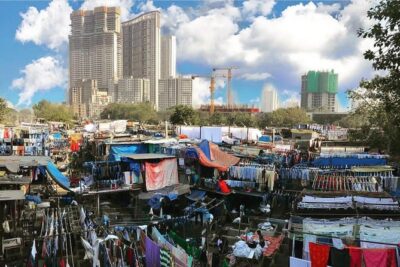
Mumbai Gems: 2-Day Private Tour with Elephanta, Slum & Dabbawala
Read our review →
Mumbai Dharavi Slum, Dhobi Ghat & Dabbawala Lunchbox Tour
Read our review →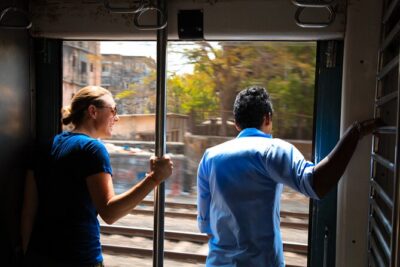
All in one Combo of City ,Slum,Dhobighat & Dabbawala tour
Read our review →
All In One Combo Tour of Mumbai City, Dabbawalas, Dhobhi Ghat, Slums & Bollywood
Read our review →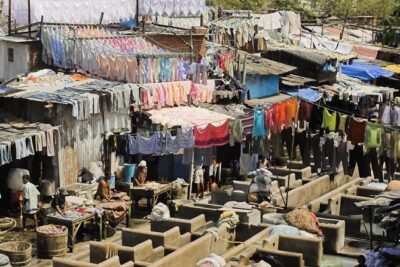
Private Dharavi Slum, Dabbawala & Dhobi Ghat tour with Transport
Read our review →Browse the lists this tour appears in