
Reviewed · MUMBAI DHARAVI SLUM TOURS
Dharavi Slum Tour
Dharavi is not simply a place of hardship. It is a working community and a major industrial center, where narrow lanes lead to recycling workshops, leather businesses, pottery kilns, bakeries, and small family-run enterprises. This tour gives you a guided look at that daily economy, rather than leaving you to form opinions from a passing train window.
I like the local guides, several of whom have personal ties to Dharavi, and I like the way the tour explains both work and home life. The community-center visit also gives your money a clear purpose. The main consideration is simple: photography is not allowed, and you must be ready to walk through crowded, modest surroundings with respect and an open mind.
Key points to know before booking
- Dharavi is an industrial center: See recycling, leather work, textiles, papadom making, and Kumbharwada pottery.
- Local guides make the difference: Guides named in tour feedback include Rakesh, Leena, Javed, Rishi, Cethan, Suraj, and Jay.
- The tour lasts about two and a half hours: Around two hours are spent walking, followed by about 20 minutes at the local office.
- Your fee supports community work: Proceeds help fund education, health, and livelihood projects.
- You cannot take photographs: This rule protects residents’ privacy and shapes how you experience the area.
- The meeting point is also the finish: You can take the train with your guide if that option is selected, or make your own way there.
Seeing Dharavi as a working community
The word slum can create a narrow picture in your mind. This walk complicates it. Dharavi is home to nearly one million people and functions as a city within Mumbai, with work, homes, schools, religious spaces, and commerce packed into a relatively small area.
You will not simply be shown poor housing and told to feel sorry for the residents. The route focuses on how people earn a living and how businesses connect to the wider city. Recycling, leather tanning, textiles, pottery, and food production all form part of Dharavi’s local economy.
That approach matters. Several guides praised in the tour feedback, including Javed and Rishi, were described as people with a close understanding of the community. One guide was from Dharavi himself. That kind of local connection can give the walk more care and accuracy, though your exact guide will depend on the day.
I also appreciate that the tour does not treat Dharavi as a backdrop for photographs. The no-camera rule may disappoint anyone hoping for dramatic street images, but it encourages you to pay attention to the people and businesses around you instead of turning residents into subjects.
More Dharavi walking tours in Mumbai
- Dharavi slum tour in Mumbai by Female tour guides of the slum
★ 5.0 · 1,976 reviews - Mumbai: Dharavi Slum, DhobiGhat, and Dabbawallas Tour
★ 4.9 · 689 reviews - Dharavi Slum tour in Mumbai by local resident
★ 5.0 · 572 reviews
Starting at 60 Feet Road
The tour begins at the Reality Tours and Travel office on 60 Feet Road, in Shahid Bhagat Singh Nagar, Kumbhar Wada, Dharavi. This is also where the walk ends, so you do not need to find a second meeting point after the tour.
You can make your own way to the office, or choose the option that includes traveling by train with the guide. Mumbai’s local rail system is central to city life, and having a guide accompany you can make the first part of the journey easier. If you have another destination afterward, the guide can help you reach the train station and advise you on returning toward Churchgate or continuing elsewhere in Mumbai.
The tour does not include hotel pickup or drop-off. Plan your route to the meeting point before departure, especially if you are staying across the city. Mumbai traffic can be slow, and one guide, Rakesh, was praised for being flexible when a group was delayed by traffic. Still, you should not count on a late start being possible.
Walking through recycling and small industry
The first main portion of the walk takes you into Dharavi’s work areas. Recycling is one of the most memorable parts of the route because it shows how much economic activity can fit into tight spaces.
You might see materials being sorted, processed, and prepared for reuse. The exact businesses operating on the day can vary, but the tour specifically includes the recycling area, textiles, and leather tanning businesses. The point is not just to observe machinery or piles of material. Your guide explains how these trades operate and why they matter to Mumbai.
This is where the tour can change your understanding of Dharavi. A place that might look chaotic at first has its own systems, skills, and networks. The lanes are narrow, the working areas are close to homes, and conditions may be basic. Yet the activity is organized and tied to the wider city’s needs.
You should wear closed-toe shoes. That practical tip comes directly from the experience of people who have taken the walk, and it makes sense for an industrial area with uneven or dirty surfaces. Modest clothing is also required. Cover your shoulders and knees, both as a sign of respect and because conservative dress is expected throughout India.
Leather, textiles, and the business of making a living
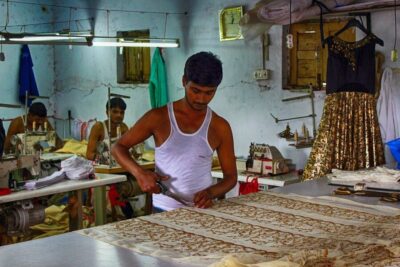
The leather and textile sections show another side of Dharavi’s economy. You are likely to see work taking place in small units rather than in polished factory spaces. That contrast is part of the lesson: a great deal of production can happen in humble surroundings, often through family or community networks.
Your guide can explain the difference between residential lanes and commercial lanes, and how the two fit together. One of the strongest parts of this tour is that it connects individual work to urban planning and everyday life. Dharavi is not only a place where people live. It is also a place where people make, repair, sort, sell, and supply goods.
This may be uncomfortable at times. Working spaces can be cramped, and the walk does not hide the physical challenges of life in a densely populated area. I would not book this expecting a polished sightseeing route. You are visiting an active community, not an open-air museum.
The respectful tone is important. Keep your voice low, listen to your guide, and do not stare into homes or workplaces. Since photographs are forbidden, you will need to remember the experience through what you learn rather than what you capture.
A completely different side of the city:
- Mumbai: Full-Day Sightseeing Tour of Mumbai
★ 4.9 · 1,822 reviews - Private Mumbai Sightseeing Tour (Traveller’s Choice Award Winner)
★ 5.0 · 1,565 reviews - Group Guided Walking Tour in Fort and Colaba
★ 5.0 · 1,073 reviews - Mumbai: Elephanta Caves Half-Day Guided Tour with Expert
★ 4.8 · 1,032 reviews
Kumbharwada pottery and rooftop views
Kumbharwada, Dharavi’s pottery colony, is another named stop on the route. It adds a craft tradition to the tour’s industrial focus. Pottery helps show that Dharavi includes many kinds of work, from recycling and manufacturing to skilled hand production.
The route also includes a rooftop visit. The information provided does not promise a particular skyline or viewing platform, so you should treat this as a short look at the community from above rather than a classic Mumbai sightseeing viewpoint. It may help you understand the density and layout of the neighborhood, especially after walking through its close-set lanes.
You may also see papadom making. This small detail is useful because it brings the tour down to the level of everyday food production. Along with bakeries and other commercial areas described by the tour’s participants, it shows how the community serves both local households and the wider city.
The walk takes roughly two hours. That is long enough to move beyond a quick glance, but short enough to fit into a full day of Mumbai sightseeing. There may be waiting or slow movement in narrow lanes, so do not schedule a tight appointment immediately afterward.
The community center and cold drink at the end
After the walking portion, you return to the Reality Tours and Travel office in Dharavi. The final stop lasts about 20 minutes and includes a soft drink or water.
This is more than a rest stop. The guide explains how money from the tour is put back into local work, including projects connected with education, health, and livelihoods. The company information says a significant portion of proceeds returns to the community, while some tour details describe the share as 80 percent. If the social purpose of your booking matters to you, ask the office for the current breakdown.
The community-center element gives the tour a practical reason for existing. You are not only paying for access to a guided walk. You are also helping fund programs, including educational work such as English learning for young people. That does not remove the ethical questions around slum tourism, but it gives you something concrete to examine when deciding if the visit feels responsible.
I would use the final conversation to ask about the projects, not just the route. It is a good chance to learn what the organization actually supports and how the money is used.
Price, timing, and what you receive
At about $20.40 per person, this is fairly priced for a two-and-a-half-hour guided walk in Mumbai, especially since it includes a local English-speaking guide, water or a cold drink, and the community contribution. Lunch is not included, though it may be available as an optional extra.
The value depends on what you want from Mumbai. If you are looking for monuments, grand interiors, or a conventional sightseeing loop, this will not replace those experiences. If you want help understanding how a large part of the city works and how its residents earn a living, the cost is easier to justify.
Group discounts are available. The maximum listed group size is 99 people, which is very large, although some tour experiences have involved groups of about 10. Ask about the expected group size when booking if personal discussion and easy movement matter to you. A smaller group will usually make it easier to hear the guide and ask questions in tight lanes.
The tour is booked, on average, about 16 days ahead. That does not mean you must reserve it that early, but it is a useful sign that you should not leave it until the last minute during a busy Mumbai visit.
Who will get the most from this walk
I would recommend this experience to you if you want context, direct explanation, and a closer look at everyday Mumbai. It suits curious first-time visitors, students, people interested in urban development, and anyone who wants to understand work and community life beyond the city’s famous sights.
It is also a good fit for solo travelers. One person who joined alone felt safe and found the guide patient and helpful, including when a previous tour caused a delay. Most people can participate, but you should be comfortable walking for about two hours and moving through narrow, active areas.
This is not the best choice if you want to take photos, shop freely, or avoid crowded neighborhoods. The no-photography policy is firm. The tour also asks you to think carefully about your behavior, clothing, and attitude.
Families may find the subject educational, but parents should decide if their children are ready to visit a working community where living conditions may be difficult to see. The tour is not presented as a children’s attraction.
Practical advice for a respectful visit
Wear light, modest clothing that covers your shoulders and knees. Choose sturdy, closed-toe shoes, carry water if you prefer more than the included drink, and leave large bags at your accommodation if possible.
Do not bring the expectation of photographing every stop. Since cameras are not permitted, your best tools are your ears and your questions. Ask before touching anything, entering a work area, or speaking with residents.
Allow extra time to reach 60 Feet Road. The meeting point is near public transportation, but Mumbai traffic can cause delays. If you select the train option, your guide can accompany you on that part of the journey.
The cancellation terms are straightforward: cancel at least 24 hours before the local start time for a full refund. Cancellations within 24 hours are not refunded, and late changes are not accepted.
Is the Dharavi tour worth booking?
I would book this tour if you want to understand Mumbai through its people and working economy, not just its landmarks. The strongest reasons are the local guides, the focus on real businesses, and the funding connection to education, health, and livelihood projects.
Go with respect and realistic expectations. You will walk through a dense, active community, not a staged attraction. If that sounds worthwhile, the Dharavi tour offers a focused two-and-a-half-hour way to see a side of Mumbai that is difficult to understand on your own.
FAQ
How long does the Dharavi tour last?
The experience lasts about two hours and 30 minutes. Around two hours are spent walking through Dharavi, followed by about 20 minutes at the Reality Tours and Travel office.
Where does the tour start?
It starts at Reality Tours and Travel on 60 Feet Road, Shahid Bhagat Singh Nagar, Kumbhar Wada, Dharavi, Mumbai, Maharashtra 400017.
Where does the tour end?
The tour ends at the same Reality Tours and Travel office where it begins. The guide can then help you reach the train station or continue toward another part of Mumbai.
Is transportation included?
You can choose an option that involves traveling by train with your guide, or make your own way to Dharavi. Hotel pickup and drop-off are not included.
What will I see in Dharavi?
The route includes the recycling area, textiles, leather tanning businesses, a rooftop visit, papadom making, and Kumbharwada pottery colony. You will also pass through commercial and residential areas.
Can I take photographs?
No. Photography is not permitted inside Dharavi out of respect for residents.
Is lunch included?
No. Water or a cold drink is included. Lunch may be available as an optional extra at an additional price.
What happens to the tour proceeds?
A significant portion of the proceeds supports community projects involving education, health, and livelihoods. The tour information also describes support for educational programs, including English learning for young people.
Recently added around Mumbai
- Mumbai Sightseeing Tour★ 5.0 · 11 reviews
- Private Walking Tour in Dharavi Slums★ 5.0 · 7 reviews
- Private Mumbai 2-Day Tour Package:City + Slum & Elephanta Island.★ 5.0 · 3 reviews
- Vegetarian Indian Cuisine Virtual Cooking Class Experience from Mumbai★ 5.0 · 4 reviews
- Mumbai by Night Guided Tour★ 5.0 · 6 reviews
- Transfer from Mumbai Airport to Hotel★ 4.0 · 7 reviews
- Full-Day Agra Tour with Taj Mahal From Mumbai By Air★ 5.0 · 8 reviews
- Taj Mahal Day Trip Including Same Day Flights from Mumbai★ 5.0 · 3 reviews
Mumbai Dharavi Slum Tours, compared.
Dharavi slum tour in Mumbai by Female tour guides of the slum
Read our review →
Dharavi Slum Slumdog Millionaire Tour with a Local
Read our review →
Mumbai Slum Tour – Visit Dharavi Slum with Local Guide
Read our review →
Dhobi Ghat Laundry and Dharavi Slum Tour with Local
Read our review →
Private Full-Day Mumbai Sightseeing Tour with Dharavi Slums
Read our review →Browse the lists this tour appears in