
Reviewed · MUMBAI MARKET AND BAZAAR TOURS
Mumbai by Dawn: Explore Markets, Docks, and Daily Life
Mumbai wakes early, and this 3.5-hour private tour takes you straight into that first rush of work, trade, flowers, fish, and laundry. You’ll see Sassoon Dock handling more than 50 tonnes of fresh catch, Dadar’s flower sellers setting out their blooms, and Dhobi Ghat at work before much of the city has properly started its day.
I like the way the tour links several very different parts of Mumbai, and I like the practical use of private transportation, especially when you need to cover markets spread across the city. Shruti leads the experience, while Arjun drives, and their teamwork helps you see a lot in a short time.
The main drawback is the early timing and brisk pace. Market visits last about 20 to 30 minutes each, so you get a strong first look rather than a long, leisurely wander. The tour starts at Regal Cinema in Colaba, although pickup is offered, so confirm the exact arrangement before you go.
Key points to know before booking
- Sassoon Dock handles more than 50 tonnes of fish: This is the tour’s most striking look at Mumbai’s working waterfront and Koli fishing culture.
- Dadar gives you two markets in one stop: The produce market and flower market show different sides of the city’s morning trade.
- CSMT is more than a photo stop: You get a close look at one of India’s great railway buildings and a station used by about 660,000 commuters each day.
- The tour is private: Only your own group takes part, which makes it easier to ask questions and keep the pace comfortable.
- Shruti and Arjun are named members of the team: Shruti handles the tour, and Arjun provides the driving.
- The price is $33.34 per person: For a private, vehicle-supported tour covering several parts of Mumbai, that can be good value, especially for a small group.
Why Mumbai at dawn is worth your alarm
Mumbai is easier to understand when you see the people who keep it supplied, clean, and moving. This tour does not focus only on grand monuments. Instead, it shows you the early work behind daily city life: fish unloaded at the docks, produce sorted for sale, flowers prepared for customers, laundry washed and dried, and commuters moving through a major railway station.
That makes the timing important. At dawn, the markets are not staged for sightseeing. They are places of work. You may see activity that is direct and practical, with little polish, which is exactly why this experience can feel more revealing than a standard city drive.
I also like the route’s variety. CSMT offers grand architecture. Sassoon Dock brings you to the waterfront and the Koli fishing community. Dadar’s markets give you color and movement, while Dhobi Ghat shows a long-running laundry operation on a huge scale.
You should still set realistic expectations. This is not a slow food tour or a shopping outing. The schedule allows roughly 20 to 30 minutes at each stop, and the entire experience lasts about three and a half hours. You will see a lot, but you will not have time to linger at every stall.
More market and bazaar tours in Mumbai
- Mumbai: Street Food and Night Markets Tour
★ 4.9 · 719 reviews - Mumbai Morning Market Tour of Flowers, Fish, and More
★ 5.0 · 100 reviews - Mumbai Morning Market Tour of Flowers, Fish, and More
★ 5.0 · 82 reviews
CSMT: Mumbai’s grand railway gateway
The first stop is Chhatrapati Shivaji Maharaj Terminus, often called CSMT and formerly known as Victoria Terminus. The building is one of India’s most impressive railway stations, with elaborate architectural details that make it worth seeing even if you are not especially interested in train travel.
The station also gives the tour a useful sense of scale. About 660,000 commuters use it each day, so this is not a quiet museum piece. It remains a central part of Mumbai’s working life.
You have about 20 minutes here, with admission included. That is enough for an exterior look and a quick appreciation of the building, but not a detailed architectural study. If you enjoy taking photographs, this is one of the easiest places on the route to pause and frame a grand city landmark.
The short stop also keeps the tour moving. CSMT is the formal opening to a route that soon shifts from monumental architecture to working markets. I like that contrast. You begin with the city’s famous public face, then move toward the people and trades that keep it running.
Sassoon Dock and the Koli fishing community
Sassoon Dock Road is likely to be the most intense stop. The dock is connected to the Koli fisherfolk, described as Mumbai’s original inhabitants, and the tour gives you a look at the arrival and grading of more than 50 tonnes of fresh catch.
That number helps explain why this is not simply a scenic harbor visit. The dock is a place of commerce and physical work. Fish arrive, get sorted, and move onward. You are seeing an important part of Mumbai’s food supply at close range.
You have about 30 minutes here, with no separate admission charge. That is the longest stop on the route, and it makes sense. The dock is more than a quick photograph. It is the place where you can best see how a traditional coastal community remains tied to the city’s modern economy.
The setting may not suit everyone. Fish markets can be wet, crowded, and strongly scented, and this is a working area rather than a polished attraction. If you prefer quiet sightseeing, this may be the least comfortable part of the morning. If you want a direct look at Mumbai’s daily trade, it is one of the most useful.
Your guide matters here. Shruti is the named tour guide, and her role is especially valuable at a place where context can turn a chaotic scene into an understandable one. Arjun’s driving also matters because the route covers several separate areas, and one direct comment about the team is that they help cover a lot of the city in the available time.
Dadar’s produce market: Mumbai’s morning supply line
The Dadar Fruit and Vegetable Market shifts the focus from the coast to the city’s food distribution. Stalls are filled with seasonal produce, including vegetables such as eggplants and okra.
You have about 25 minutes to take in the market. That is enough to see the range of goods and watch the rhythm of local trade, but it is not enough for a long, unhurried browse. Think of this as an introduction to the market’s scale and purpose.
I like this stop because it connects naturally with Sassoon Dock. At the dock, you see seafood arriving from the water. In Dadar, you see produce gathered and offered for sale. Together, the two stops show Mumbai as a city that depends on fast-moving supplies.
The market may also be easier for some people than the fish dock. The sights are still busy, and the route may feel crowded, but the subject is familiar: vegetables, fruit, sellers, and customers. You can focus on the details without needing to adjust to the stronger conditions of the waterfront.
Do not expect a shopping break unless your guide has time and the market allows it. The purpose is to observe the trade and understand the setting. The schedule is tight, so keep your attention on the stalls rather than assuming you will have time to stop at every one.
More early morning tours in Mumbai
- The Original Mumbai by Dawn – Recommended by Nigella Lawson & Nat Geo Traveller!
★ 5.0 · 610 reviews - Mumbai Private Sunrise/Sunset Sailing 8ppl Boat Tour
★ 4.5 · 86 reviews - Mumbai: Morning Bicycle Tour
★ 5.0 · 40 reviews - The Colourful Early Morning Tour
★ 5.0 · 31 reviews
Dadar Flower Market in full color
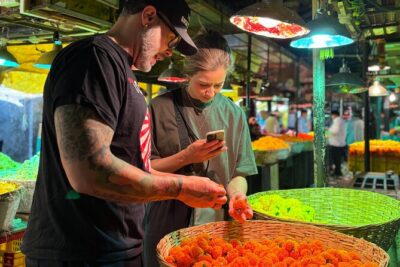
The flower market is one of the tour’s most photogenic stops. Vendors sell fresh flowers ranging from fragrant marigolds to orchids, and the market fills the air with floral scents and strong color.
You have about 25 minutes here. That gives you time to appreciate the flowers, watch sellers prepare their displays, and take photographs. The market is a good counterpoint to the produce market next door or nearby on the route: both show trade, but the flowers bring a different mood and visual character.
This stop also gives you a glimpse of how flowers function as everyday goods rather than simple decoration. The market is tied to local buying and selling, and the quick turnover is part of what makes the scene interesting.
The practical issue is the same as at Dadar’s produce market. You will probably wish you had longer. The tour’s strength is its range, but its schedule means you get a concentrated visit at each place. If the flower market is your main reason for booking, ask about the exact timing and how long your group can remain there.
Dhobi Ghat and Mumbai’s open-air laundry
Dhobi Ghat is the final listed stop, with about 20 minutes allocated. It is known as the world’s largest open-air laundry, where dhobis wash and dry thousands of garments.
The scale is the key point. This is not a single small washing area. It is a large working operation, and the sight of garments being handled across an open-air setting gives you another view of the labor behind city life.
I appreciate the way this stop broadens the route. You begin with transport at CSMT, see fish and produce entering the city, pass through flower commerce, and finish with laundry work. The route is really about systems: how Mumbai moves people, food, flowers, and clothing.
Twenty minutes is enough for an overview, particularly if your guide explains what you are seeing. It is not enough for an extended visit or detailed study of the operation. You should expect a focused stop, not a full tour of every part of the laundry.
Because Dhobi Ghat is a working place, the best approach is to observe respectfully and follow your guide’s directions. The tour provides a window onto the operation, not an invitation to wander wherever you wish.
How the private transport changes the experience
The route covers Colaba, the waterfront, Dadar, and Dhobi Ghat. That is a lot of ground for one morning. Private transportation is therefore more than a comfort feature. It is what makes the itinerary practical.
You are not left to work out several transfers before sunrise, and you do not need to spend your limited time figuring out how to connect distant areas. Arjun is the named driver, and the available feedback specifically highlights his friendly manner and help covering much of the city.
The tour is private, so only your own group participates. That gives you a better chance to ask Shruti questions or adjust small details within the schedule. It also avoids the uncertainty of joining a large group with different interests.
Pickup is offered, but the stated meeting point is Regal Cinema on Colaba Causeway, opposite the Chhatrapati Shivaji Maharaj Vastu Sangrahalaya, at Apollo Bandar. Since those details can affect your morning plans, confirm whether pickup applies to your accommodation or whether you should go to Regal Cinema.
The tour ends back at the meeting point. That is useful if you want to continue exploring Colaba afterward, but it also means the experience does not function as a one-way transfer to another part of Mumbai.
Is $33.34 good value?
At $33.34 per person, the value depends on your group size and how much you value private transport. You are paying for a three-and-a-half-hour route with several stops, a guide, and a driver rather than for entry to one major attraction.
For a small group, the price is reasonable because the tour covers a wide area and avoids the hassle of arranging separate transport between each market. The private format also gives you more control than a large shared excursion.
Group discounts are offered, which may improve the price for larger parties. The tour is booked, on average, 27 days ahead, so it is sensible to reserve early if your Mumbai dates are fixed.
The value is weaker if you want long visits, shopping time, or a relaxed breakfast-focused morning. The schedule is designed for range and access. You see five distinct places, but none receives a very long stay.
Free cancellation is available if you cancel at least 24 hours before the start time. Changes or cancellations made less than 24 hours ahead do not qualify for a refund, so keep that cutoff in mind when fixing your plans.
Who should book this Mumbai morning tour?
I would recommend it to first-time visitors who want to understand Mumbai beyond its headline sights. It is also a good choice if you have only a short stay and want to cover several working parts of the city in one morning.
The tour suits photographers, people interested in food supply and local trade, and anyone curious about the daily work that supports a major city. The flower market and CSMT offer strong visual subjects, while Sassoon Dock and Dhobi Ghat provide more social and economic context.
It may be less suitable if you dislike early starts, strong market smells, wet working areas, or quick stops. It is also not ideal if your priority is shopping, since the schedule is built around observation rather than browsing.
Most people can participate, and the tour is near public transportation. Still, the private vehicle is the real convenience, since the stops are spread across Mumbai and the morning schedule leaves little room for delays.
Should you book it?
Book this tour if you want a compact, practical look at Mumbai’s working life, not just its famous buildings. The best reasons are the Koli fishing connection at Sassoon Dock, the two Dadar markets, and the private transport that ties distant stops together.
Skip it if you want a slow morning or a single subject explored in detail. At $33.34 per person, the tour offers good value for a small group that wants breadth, local context, and named support from Shruti and Arjun. Confirm your pickup details, prepare for an early start, and expect a brisk route with plenty to see.
FAQ
How long does the Mumbai by Dawn tour last?
The tour lasts approximately 3 hours and 30 minutes.
Where does the tour start?
The stated meeting point is Regal Cinema on Colaba Causeway, opposite the Chhatrapati Shivaji Maharaj Vastu Sangrahalaya, in Apollo Bandar, Colaba, Mumbai.
Where does the tour end?
The activity ends back at the meeting point.
Is hotel pickup available?
Pickup is offered, but the provided meeting information also lists Regal Cinema as the start point. Confirm the pickup arrangement when booking.
Is this a private tour?
Yes. Only your own group participates in the activity.
What places are included?
The route includes Chhatrapati Shivaji Maharaj Terminus, Sassoon Dock Road, Dadar Fruit and Vegetable Market, Dadar Flower Market, and Dhobi Ghat.
How much does the tour cost?
The listed price is $33.34 per person. Group discounts are available.
What is the cancellation policy?
You can cancel for a full refund up to 24 hours before the experience starts. Cancellations or changes made less than 24 hours before the start time are not accepted for a refund.
Recently added around Mumbai
- Private Walking Tour in Dharavi Slums★ 5.0 · 7 reviews
- Mumbai Sightseeing Tour★ 5.0 · 11 reviews
- Private Mumbai 2-Day Tour Package:City + Slum & Elephanta Island.★ 5.0 · 3 reviews
- Vegetarian Indian Cuisine Virtual Cooking Class Experience from Mumbai★ 5.0 · 4 reviews
- Mumbai by Night Guided Tour★ 5.0 · 6 reviews
- Transfer from Mumbai Airport to Hotel★ 4.0 · 7 reviews
- Full-Day Agra Tour with Taj Mahal From Mumbai By Air★ 5.0 · 8 reviews
- Taj Mahal Day Trip Including Same Day Flights from Mumbai★ 5.0 · 3 reviews
Mumbai Market and Bazaar Tours, compared.

Mumbai Morning Market Tour of Flowers, Fish, and More
Read our review →Mumbai Morning Market Tour of Flowers, Fish, and More
Read our review →
Mumbai Street Food Tour with Evening Bazaar Walk
Read our review →

Mumbai Street Food & Bazaar Tour with Local Transport
Read our review →
Vibrant Markets of Mumbai (2 Hours Guided Walking Tour)
Read our review →Browse the lists this tour appears in